
Can a Company Legally Exist and Operate Without a Bank Account? A Compliance Reality Check
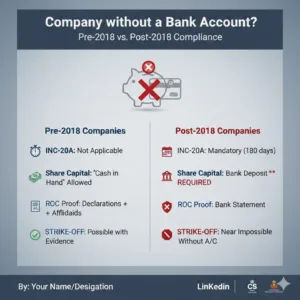
We recently navigated a unique strike-off case for a client incorporated in 2010. The company had been operational for nearly a decade before becoming inactive in 2019. Throughout its 14-year lifespan, it never opened a formal bank account.
When filing for voluntary strike-off (Form STK-2), the Registrar of Companies (ROC) raised a typical query:
“Provide the last three years’ bank statements.”
For most, this would be a dead end. However, by leveraging specific legal provisions and alternative evidence, we secured the STK-6 public notice within a week. This case highlights a critical question: Is a bank account a legal prerequisite for a company’s existence?
______________
The Legal Standing: Existence vs. Functionality
Technically, a company’s legal existence begins the moment it receives its Certificate of Incorporation (COI). It is a separate legal entity regardless of its banking status.
The Pre-2018 vs. Post-2018 Divide
The compliance landscape shifted dramatically with the introduction of Section 10A in 2018:
• Pre-2018 Era: Companies could exist and even conduct minor operations using “Cash in Hand” or “Director’s Funds.” There was no mandatory filing requiring bank proof of subscription money.
• Post-2018 Era: Newly incorporated companies must file Form INC-20A (Commencement of Business) within 180 days. This form requires a bank statement showing that every subscriber has paid for their shares. Practically, this makes a bank account mandatory for all new entities.
______________
Rules for Voluntary Strike-Off (Section 248)
If your company is inoperative and you wish to close it voluntarily, you must follow the procedure under Section 248(2) of the Companies Act, 2013.
The “Two-Strike” Rule: Resubmission Limits
Under the Companies (Removal of Names) Amendment Rules, 2022, the MCA introduced a strict resubmission policy to speed up the process:
• First Resubmission: If the ROC finds the application defective, they grant 15 days to rectify.
• Second Resubmission: If defects persist, a final 15-day window is allowed.
• Finality: If the defects are not cleared after two resubmissions, the ROC treats the application as invalid. You must file a fresh application and pay the Rs.10,000 fee again.
______________
Frequently Asked Questions (FAQs)
Q1: How can a company do business without a bank account?
In older regimes (Pre-2018), companies often operated through “Cash in Hand” or by using Director’s personal funds, which were accounted for as “Unsecured Loans” in the company’s books. While legally possible for micro-entities, it is practically impossible for modern businesses due to digital tax mandates.
Q2: How was the initial share subscription paid if there was no bank account?
For companies incorporated before the INC-20A mandate, the subscription money was often received in cash and reflected as “Cash in Hand” on the first audited Balance Sheet. The Auditor would certify the receipt based on the cash ledger.
Q3: What documents are required if the ROC asks for bank statements but none exist?
You must provide a Director’s Declaration on an affidavit confirming no account was ever opened, supported by a Cash Ledger and Creditor No-Dues Certificates confirming that all liabilities were settled outside of a banking channel.
Q4: Are there risks involved in settling company liabilities in cash?
Yes. You must ensure compliance with Section 269ST (prohibiting cash receipts of ₹2 Lakh or more) and Section 269T (prohibiting cash repayment of loans/deposits of ₹20,000 or more) of the Income Tax Act. Exceeding these limits can lead to heavy penalties during the strike-off scrutiny.
Q5: Can the ROC reject a Strike-Off application just because there is no bank account?
The ROC cannot reject it solely on these grounds if the company was incorporated before 2018. However, they can (and will) scrutinize how the company functioned. Providing a clear trail of “Cash in Hand” and “Management Representation Letters” is key to approval.
______________
Key Takeaway for Professionals
While a company can legally exist without a bank account, it is “comatose” for all practical purposes in today’s digital regulatory environment. For older entities, closing them requires a deep understanding of the law’s transition.
Pro-Tip: Always ensure “Cash in Hand” on your balance sheet does not exceed statutory cash transaction limits before applying for strike-off to avoid scrutiny from Income Tax authorities.
Leave a Reply